
Prospice: The Unknown World of Surgical Robotics- Dr Manjunath Haridas
We believe minimally invasive care is life-enhancing care
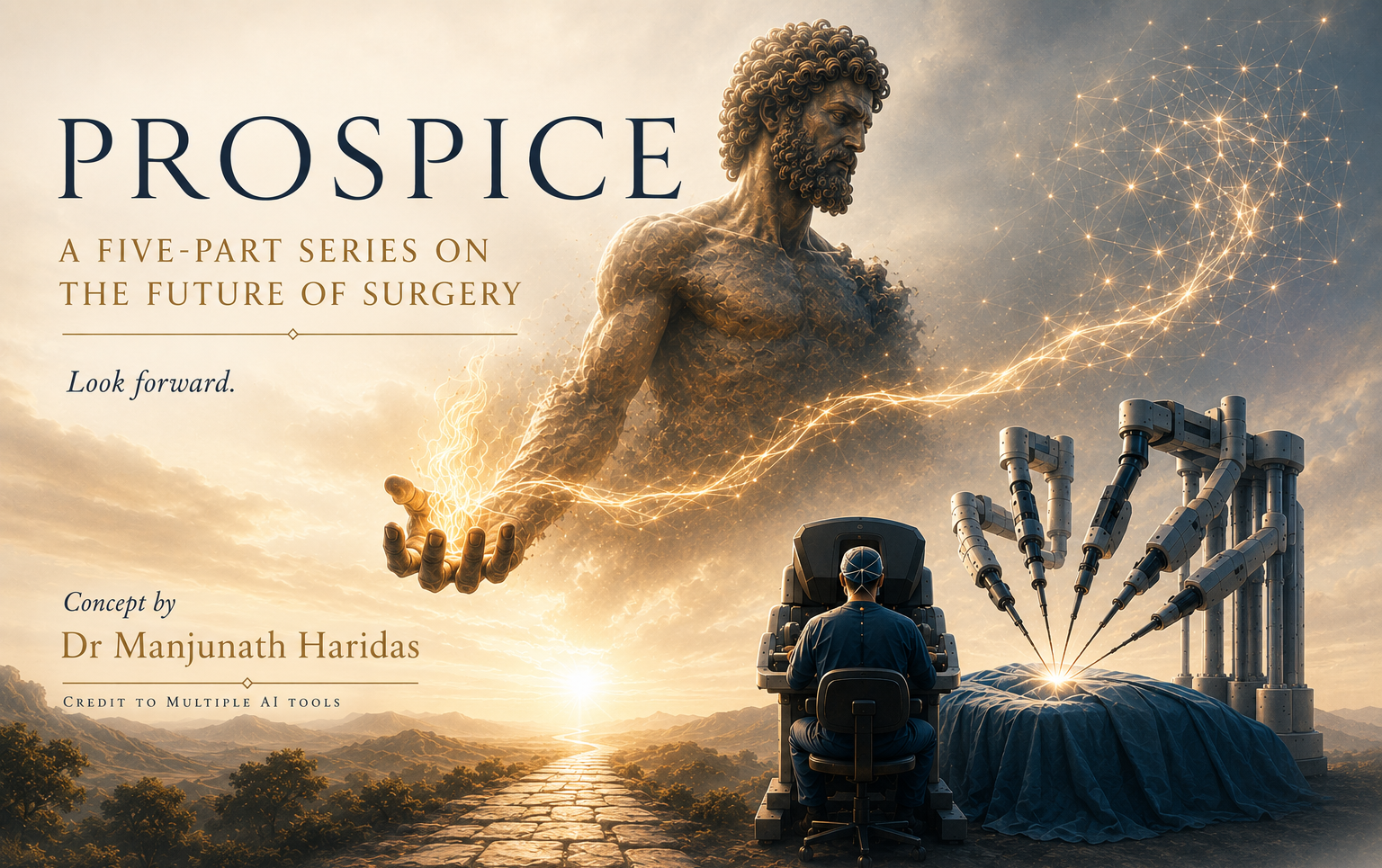
Prospice: A Five-Part Series on the Future of Surgery
For most of the history, surgery has been told through the work of the hand and the brain( the hand-eye coordination) at the centre of every operation. Every instrument, and every year of training, was built to make that coordination more refined. Robotic surgery is the latest step in that evolution: a finer hand, freed of tremor, working through smaller wounds.
But something is changing now that the old story cannot hold. For the first time, artificial intelligence in the operating room is beginning to move the thinking itself, from the surgeon into the system. Machines are starting not just to obey, but to anticipate, to suggest, and in narrow tasks, to act. It raises questions that precision alone was never asked to answer. Who decides? Who is responsible? What is left for the surgeon to hold? And where does this end?
I write this not as a futurist but as a surgeon who operates with these machines, and who would rather understand where they are taking us than be carried there without looking.
Two old words frame the series. Prospice, Latin for look forward. And Prometheus, who stole fire for humankind and was made to answer for the gift. Between them lies the real subject: a powerful new capability, and the weight of carrying it well.
Across five essays, the series moves from the technology of today to the horizon ahead. Not a prediction that a robot will replace the surgeon, but an account of a discipline in the middle of changing what it is.
Look forward.
Social Connect


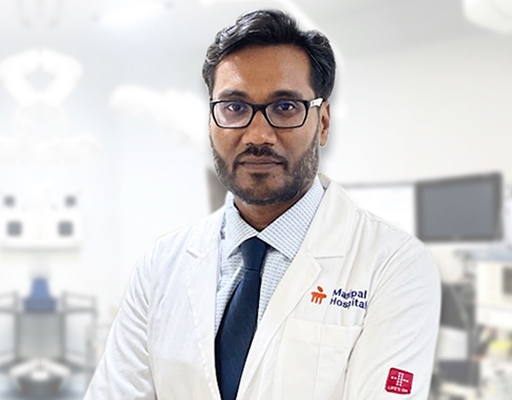
Author: Dr. Manjunath Haridas (MD FACS FICS)
Dr. Manjunath Haridas is a leading robotic surgeon based in Bangalore, renowned for his expertise in advanced robotic and laparoscopic surgery. He uses cutting-edge robotic technology to deliver precise and effective surgical care, solidifying his reputation as a pioneer in robotic-assisted surgery.