
Robotic Repair of a Recurrent Complex Lower Abdominal Wall Hernia in a High-Risk COPD Patient: Clinical Case #001
We believe minimally invasive care is life-enhancing care
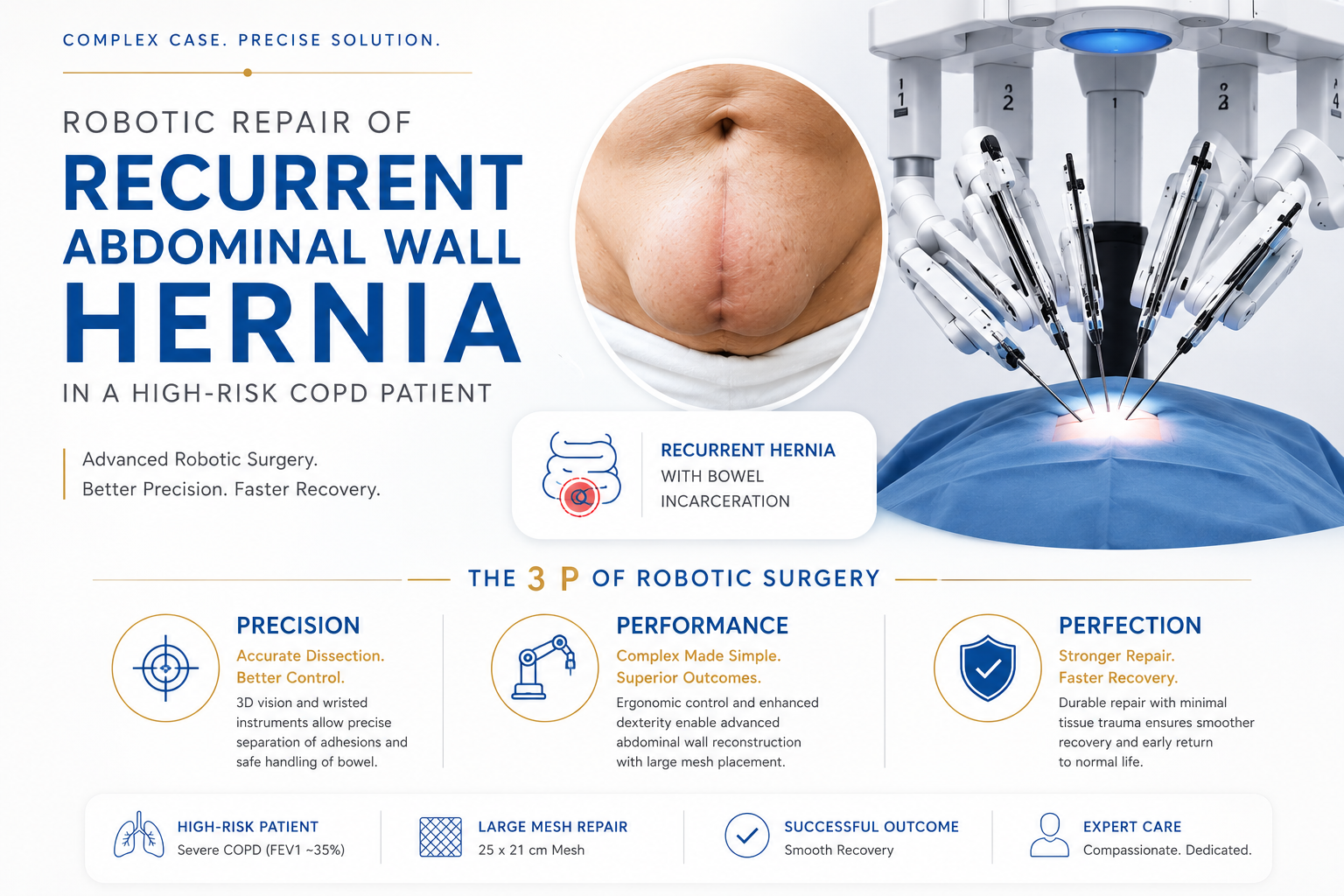
Robotic Repair of a Recurrent Complex Lower Abdominal Wall Hernia in a High-Risk COPD Patient
8 min read • Complex Hernia • Robotic Surgery
| Case Summary | Details |
|---|---|
| Age | 50 Years |
| Gender | Female |
| Diagnosis | Recurrent Lower Abdominal Wall Hernia with Bowel Incarceration |
| Procedure | Robotic Abdominal Wall Reconstruction |
| Complexity | ★★★★★ Complex |
| Previous Operations | Two Prior Abdominal Surgeries |
| Major Risk Factor | Severe COPD (FEV1 ~35%) |
| Mesh Used | 25 × 21 cm Prosthetic Mesh |
| Outcome | Successful Repair with Uneventful Recovery |
Why This Case Matters
Repairing a recurrent abdominal wall hernia after previous surgery remains one of the most technically demanding procedures in abdominal wall reconstruction. Dense adhesions, distorted anatomy, previous repairs, and severe medical comorbidities significantly increase operative complexity and the risk of complications.
This case highlights how robotic-assisted abdominal wall reconstruction enabled safe adhesiolysis, precise reconstruction, and durable mesh placement in a patient with severe chronic obstructive pulmonary disease (COPD), multiple previous abdominal surgeries, and an incarcerated recurrent hernia requiring urgent surgical intervention.
Patient Presentation
A 50-year-old woman presented with progressive lower abdominal pain and swelling. Her symptoms had worsened over several days, raising concern for recurrence of her abdominal wall hernia with possible bowel involvement.
She had undergone: Open umbilical hernia repair.Lower abdominal laparotomy with primary fascial closure (without mesh) approximately two months earlier. Because of worsening pain and increasing swelling, urgent imaging was performed.
Diagnostic Evaluation
Contrast-enhanced CT imaging demonstrated a recurrent lower abdominal wall hernia containing small bowel loops with associated mesenteric inflammatory changes. The radiological findings were concerning for early bowel incarceration and increasing risk of bowel obstruction or strangulation.
Considering the patient’s symptoms together with the imaging findings, urgent surgical intervention was recommended.
Why This Patient Was High Risk
The patient had severe chronic obstructive pulmonary disease requiring daily inhaler therapy.
Despite two weeks of pulmonary optimisation and multidisciplinary assessment, pulmonary function remained significantly compromised with an FEV1 of approximately 35%.
Although prolonged ventilation and postoperative respiratory complications were recognised risks, delaying surgery carried an even greater danger of bowel strangulation and emergency bowel resection.
After careful discussion, robotic surgery was selected because it offered the best opportunity to minimise abdominal wall trauma while maximising surgical precision.
Why Robotic Surgery Was Chosen
Complex recurrent hernias following previous abdominal surgery often involve dense scar tissue, distorted tissue planes and bowel adherent to the abdominal wall.
The robotic platform provided several important advantages:
High-definition three-dimensional magnified vision
Wristed instruments with enhanced dexterity
Precise adhesiolysis around bowel and previous mesh
Superior intracorporeal suturing capability
Reduced tissue trauma
Improved abdominal wall reconstruction
Potential for faster postoperative recovery
For this patient, minimising postoperative pain and preserving respiratory function were especially important because of severe COPD.
Surgical Technique
Following induction of general anaesthesia, diagnostic laparoscopy confirmed dense adhesions involving the omentum, small bowel and previous operative field.
A top pelvic docking approach was utilised.
Meticulous robotic adhesiolysis was performed, allowing careful separation of the incarcerated bowel from both the hernia defect and previously incorporated mesh without bowel injury.
Bilateral posterior rectus sheath release was then performed through the posterior rectus planes to create an adequate retromuscular space.
Following closure of the peritoneum, a large 25 × 21 cm prosthetic mesh was positioned securely to reinforce the abdominal wall reconstruction.
The robotic platform facilitated precise dissection and intracorporeal suturing throughout the procedure.
Technical Challenges
Several factors contributed to the complexity of this operation.
The previously implanted mesh was densely incorporated into surrounding tissues, requiring meticulous dissection to avoid bowel injury.
Significant diastasis recti was present with an extremely thin midline peritoneum.
Complete correction of the diastasis was intentionally avoided because aggressive dissection around the incorporated mesh could have compromised tissue integrity.
Instead, the peritoneum was preserved and reconstructed while maintaining a durable tension-free repair.
The 3 Ps of Robotic Surgery in Action
Precision
Advanced robotic optics and wristed instruments enabled meticulous adhesiolysis around densely adherent bowel and previously incorporated mesh while avoiding bowel injury.
Performance
Bilateral posterior rectus sheath release together with retromuscular mesh placement allowed advanced abdominal wall reconstruction despite distorted anatomy.
Perfection
Despite severe COPD and multiple previous abdominal surgeries, the patient was successfully extubated immediately after surgery, recovered well, and was discharged without postoperative complications.
Postoperative Recovery
The patient was extubated successfully in the operating room.
Aggressive postoperative pulmonary care, including nebulisation therapy and early mobilisation, was initiated immediately.
Recovery was uneventful, with no respiratory complications or need for prolonged intensive care.
The patient was transferred directly to the surgical ward and discharged following satisfactory recovery.
Key Learning Points
Every recurrent hernia requires individualised operative planning.
Robotic surgery enables safe adhesiolysis in hostile abdomens.
Posterior rectus sheath release facilitates durable retromuscular mesh reconstruction.
Careful preservation of tissue planes improves safety during redo abdominal wall reconstruction.
High-risk pulmonary patients may particularly benefit from minimally invasive robotic surgery.
Key Takeaway:
Robotic surgery enabled safe adhesiolysis and durable abdominal wall reconstruction in a patient with severe COPD and multiple previous surgeries, avoiding bowel injury and supporting rapid postoperative recovery.
Frequently Asked Questions
Is robotic hernia surgery safe after previous abdominal surgery?
Yes. Previous abdominal operations frequently result in scar tissue and adhesions. The robotic platform provides enhanced visualisation and dexterity, allowing careful dissection while minimising injury to surrounding structures.
Can patients with severe COPD undergo robotic surgery?
Many patients with COPD can safely undergo robotic surgery following appropriate pulmonary optimisation and multidisciplinary evaluation. Treatment should always be individualised.
Why was robotic surgery chosen instead of open surgery?
Repeat open surgery may increase postoperative pain, wound complications and recovery time. Robotic surgery offers superior visualisation and precision, making it particularly valuable in complex recurrent hernias.
What is posterior rectus sheath release?
Posterior rectus sheath release is an advanced abdominal wall reconstruction technique that creates space for large retromuscular mesh placement while allowing a tension-free and durable repair.
Conclusion
This case demonstrates the versatility of robotic abdominal wall reconstruction in managing complex recurrent hernias in high-risk patients.
Despite severe COPD, multiple previous abdominal operations, dense adhesions and distorted anatomy, robotic surgery enabled safe adhesiolysis, advanced abdominal wall reconstruction and excellent postoperative recovery.
With appropriate patient selection, meticulous surgical planning and advanced robotic technology, even highly complex abdominal wall hernias can be managed safely while minimising patient morbidity.
Related Reading
Robotic Hernia Surgery
Recovery After Robotic Hernia Surgery
Robotic Surgery vs Laparoscopic Surgery
Cost of Robotic Surgery
Preparing for Robotic Surgery
Wondering if Robotic Surgery Is Right for You?
Every patient is unique. If you have been diagnosed with a recurrent abdominal wall hernia or have previously undergone unsuccessful hernia repair, a consultation can help determine whether robotic surgery is the most appropriate treatment option.
Disclaimer: Patient information has been anonymised to protect privacy. This case is presented for educational purposes with appropriate consent and should not replace personalised medical advice.

Social Connect


Author: Dr. Manjunath Haridas (MD FACS FICS)
Dr. Manjunath Haridas is a leading robotic surgeon based in Bangalore, renowned for his expertise in advanced robotic and laparoscopic surgery. He uses cutting-edge robotic technology to deliver precise and effective surgical care, solidifying his reputation as a pioneer in robotic-assisted surgery.